Should I Pause a Difficult Conversation with My Spouse?

I’ve been asked this question, and I suppose some might say the obvious answer is yes, and that’s often true. A pause can allow both spouses to collect their thoughts. It can be a useful tool to prevent further sinning in a conversation. If we’re not finding a solution, it can give us time to brainstorm other ideas. Those are all good uses of a conversational pause.

But we are sinners and certain dynamics in some marriages make this a more complicated question. A hypothetical Christian couple can do this. However, an actual Christian couple brings their conversational history into it, so they may not be able to do it.

Our sin is so deceptive. We can justify it at times as if it’s actually godliness. So we pause a conversation ostensibly to help us both get control of our emotions and keep from sinning against each other, but maybe it’s actually a way of exiting a difficult conversation when I’m not getting the agreement I want. So I’m claiming the pause is to edify, but it’s actually to control.

Let’s talk about some dangers first.

Dangers:

  • You pause so that you can prove to be the better person.

It’s not your struggle; it’s hers. Beware of anything that puts you in the place of the superior person. Beware of how subtle pride can be. Pride is the sin we are most blind to (1 Cor 10:12; Rev 3:17).

  • It could be a way of controlling the discussion and your spouse.

If you’re the one predominantly calling for the timeouts, it puts you in the driver’s seat. You are controlling if, when, and how you talk about difficult topics. You are a conversational dictator.

  • It can be a way of preventing your spouse from disagreeing with you and/or speaking freely to you.

Any time the conversation gets too personal, or gets too close to your sin, you put a halt to it. You might claim that your spouse is getting upset and it’s for her good. It becomes a conversational weapon rather than a tool to edify.

If you honestly think through your motivations (maybe asking your spouse for her input), and these dangers don’t apply, then consider how best to institute a pause.

Guidelines for Pausing Conversations:

These are just practical tips. I hope they are a help.

  • It’s understood to be an unusual activity. It cannot be a regular discussion tool.

If you cannot get through a difficult conversation with your spouse without pausing, then you probably need the assistance of a wise mentor, pastor, or biblical counselor. Habitually pulling this card will likely be seen as condescending or controlling. You’re ending conversations when you sense sin in your spouse. It’s very convenient because it also allows you to avoid difficult topics that might expose your heart (Mt 15:18; Mk 7:20-23).

  • The process is described beforehand and agreed to by both.

For example, I will raise my hand when I think we might need to pause. The other person talking will stop and give me a chance to explain why I want a pause. If the non-pausing spouse has sinned, they will admit and ask forgiveness.

I’m not necessarily suggesting these; but you need some guidelines for how to pause.

  • No pausing to avoid disagreement. That’s not a reason to pause.

 Just because you don’t like the topic or it is an area of regular disagreement in your marriage, doesn’t mean you shouldn’t talk about it. Those are the types of conversations that spiritually mature couples should be able to have.

  • The person sinning ultimately calls the timeout. Not the person sinned against. And especially not the person presuming the other will sin before they’ve sinned.

If you are consistently pausing when you notice sin in your spouse, it will appear condescending and it probably is. It’s as if you are saying, “I have the discernment to see where you are headed; you don’t. I’m level-headed and you are emotional and headed towards anger.” So you  cut her off before she sins. It’s better for the sinning spouse to call for a pause to avoid further sin.

  • You have to be willing to have difficult conversations with heightened emotions. Your spouse must know that you will let her disagree.

I’m not saying that yelling and name calling are acceptable in a conversation with your spouse. They never are. I am saying that just because one or both of you is passionate/emotional is not a reason to stop talking. You’re different personalities. One of you might get more passionate, but passion alone doesn’t mean we are sinning in how we speak. Follow through as long as it is heading towards a solution.

We have to talk to solve problems. It’s not an option to sweep stuff under the rug. We cannot pretend problems don’t exist. And we must not use pausing a conversation to avoid difficult topics. A pause can be a helpful, occasional tool if we’re honestly trying to edify each other.

Husband, Unlock Your Phone!

When we lived in North Carolina, our neighborhood had a pool, and my wife and kids were there all the time. Sometimes my family would have lunch at the pool and I would meet them there. I would drive there, eat, change clothes, jump in the pool with the kids, change back, and drive to work. We had four kids which wasn’t so many that I couldn’t count them. 😉 I’d look for my almost three-year-old Riley and not see him in or around the pool. Turns out he was hiding in the shadows under the cabana. If I caught him under there, he would say something fearfully like, “Are you going back to work soon, Dad?” because he was nervous that I would take him to the “deep water” and make him jump off the side. And that’s exactly what I wanted to do.

He thought hiding in the shadows was the place to be. I thought bringing him out into the sunshine was a better idea. Better for him to come out into the light and deal with his fear of the water.

It seems better to hide in the shadows, but God encourages us to come out into the light.

It happened again recently, but it’s a story that is repeated over and over again throughout the last 20 years of ministry. A wife knows that something is wrong in her marriage, but she cannot figure out what is going on. Or maybe she actually suspects that her husband is unfaithful.

What’s a common warning sign that I’ve seen pretty much since the advent of the cellular phone? “Well, he wouldn’t let me look at his phone. He was really secretive about it.”

A husband that won’t let you look at his phone is a big deal. I cannot think of a good reason for why a husband would keep his phone private from his wife. He’s hiding something.

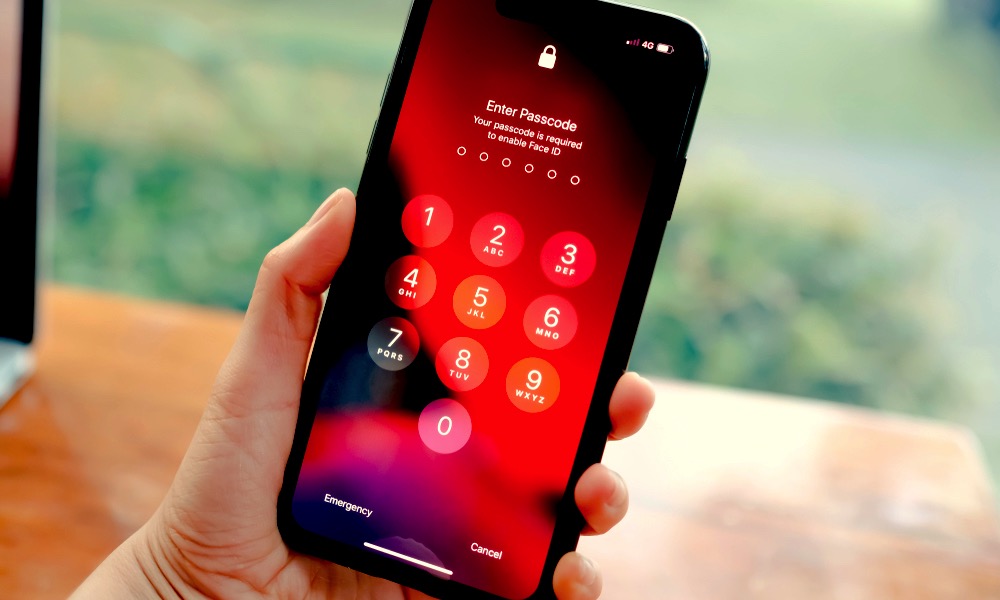
Husband, unlock your phone!

I’m saying unlock it, but I really mean give your wife your password. My iPhone has two faces that can open it: mine and my wife’s. She and my adult kids know the numeric password. Why do you need your phone locked from your family? Live in the light.

Of course unlocking your phone means nothing if you aren’t going to give up your sin. The problem isn’t the advent of passwords on phones, The problem is that too many men are hiding who they really are.

Proverbs 28:13 (ESV) Whoever conceals his transgressions will not prosper, but he who confesses and forsakes them will obtain mercy.

Don’t pretend to be what you are not. The locked phone is just a symptom of a heart that likes to hide in the dark. What this verse is saying is that when I have an attitude that says I must cover myself; I must hide my sin, I won’t prosper. I won’t be growing at the rate that God wants me to.

Take some steps out into the open. Have a lifestyle of transparency. Your marriage needs this. You need this. Husband, unlock your phone.

The Hidden Life Is Not the Godly Life

My children are all adults now, but I remember when the younger two went through a period where they liked my wife to play hide and seek with them. It was a fun game that was made more fun by the fact that my two youngest were such lousy hiders—like all little kids are. They loved to hide in plain view. They loved to get caught.  They giggled when you got near them. They hid in the very last place my wife hid in. And of course, they wanted all the lights on when they played. Basically, every rule that makes a good hider they violated.

It’s okay because it’s just a game of hide and seek.

Too often in marriage counseling I encounter the couple that hides things from each other. In fact, occasionally they want to include me in their deceit. “Now don’t tell my wife this, but….” Some couples hide things big and small from each other. It’s one reason why their marriage is a mess. They’re adversaries, not teammates. But other couples, many couples, hide small things from each other. It’s the belief that a small lie is not harmful to a relationship.

I see it in couples I counsel, but I also see it in myself. In my first pastoral position I was an assistant pastor in a suburb of Denver. My wife and I normally went to bed at the same time, but occasionally, as we were about to get into bed, I would tell my wife I needed to do something quick in the home office. I would do it and then get in bed.

When my wife would ask what I was doing, I would say something non-committal.

Want to know what I was doing? It’s probably not what you think. I was reading my Bible. I would go to the office, open my Bible, read a verse or maybe two, close it, and go back to the bedroom. I was ashamed that I was an assistant pastor that had managed to go the entire day without reading the Bible at all. I didn’t want my wife to know I was that kind of guy; that some days I didn’t read God’s Word. It was hiding and it was wrong, so I eventually told her.

I didn’t want her to know who I really was. But choosing dishonesty pushed us farther apart, not closer together.

The hidden life, no matter how small, is not the godly life.

In a passage where the Apostle John talks about God’s essence being light and uses that to encourage us to walk in the light, he drops this.

1 John 1:7 (ESV) But if we walk in the light, as he is in the light, we have fellowship with one another, and the blood of Jesus his Son cleanses us from all sin.

We would expect in this passage that John would say that walking in the light leads to greater fellowship with God, and that’s true (1 John 1:9). But isn’t it surprising that this passage says walking in the light leads to greater fellowship with other believers?

Walking in the light means not hiding or evading. it means being honest about who and what I am. Dishonesty moves us away from people. Walking in the light moves us closer. So no small amount of hiding is insignificant.

The recent revelations about Ravi Zacharias have saddened us all. But one part of it didn’t surprise me. When the board examined the initial accusations against him in 2016, it’s been widely reported that he had 3 phones and wouldn’t turn any of them over to the board. It happens over and over again with unfaithful spouses. A spouse that doesn’t let the other spouse see their phone is a bad sign. What is he hiding on his phone?

That’s the dramatic example, but what small, seemingly insignificant thing are you hiding from your spouse? Is it the pre-supper Big Mac (probably the greatest sandwich American ingenuity has ever developed)? Is it a conversation you had with one of your kids? Is it an Amazon purchase? Is it a traffic ticket? Is it a show that you stream until she walks in the room? Every choice to hide is a choice to move further from your spouse, not closer.

Our God is light and he wants us to walk in the light (1 John 1:5-2:2). Come out into the light. You’ll enjoy more genuine fellowship with other believers–especially those closest to you.