


The Dignity of Human Life
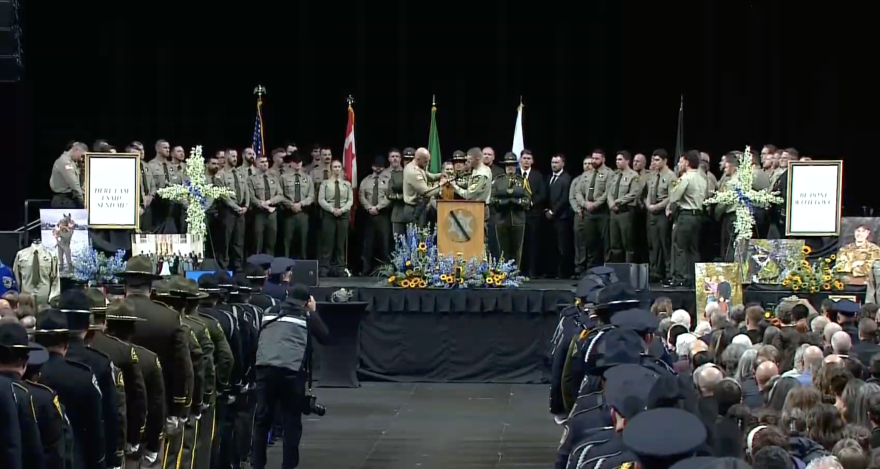
A week ago I attended a public memorial service for two Spokane County (WA) Deputies who were killed in the line of duty. They were trying to protect innocent people in a domestic incident, but were shot by the criminal themselves. It is a sad and tragic story. As a pastor I have done many funerals, but I had never attended a public memorial for fallen officers. It was somber and dignified and appropriately long—almost 2.5 hours.
The reason I attended is one of the deputies was the son-in-law of members of my church. The father-in-law spoke as the final testimony (out of seven). With him and another church member I’ve literally shared 50 cups of coffee over the three years I’ve been here. At our best we are a weekly spiritual accountability group.
The Spokane County Sheriff’s Lieutenant that emceed prepared us at the beginning for the many traditional elements of the ceremony that are specific to law enforcement funerals.
Those included:
- All officers in attendance (and there must have been 500 to 1000) wore a black elastic band horizontally across the center of their badges
- An honor guard composed of dozens of members of many different departments of law enforcement
- The honor escort of the family
- The national anthems—yes, plural! Both O Canada and The Star Spangled Banner were sung. Canadian law enforcement attended too—I saw a Mountie.
- Bag pipes and drums at the beginning and end of the ceremony. At the conclusion they played Amazing Grace.
- A color guard bringing national, state, county, and department flags to the stage and then removing them at the end.
- Memorial ribbons added to a flag standard where all the Spokane County Sheriff’s Officers in attendance came on stage in a solemn ceremony.
- Flag folding and presentation to the surviving spouses
- The playing of Taps
- A 21 gun salute inside the arena.
- And probably the most moving element was the Last Call where we heard dispatch broadcast the officer’s call sign over the police radio. After receiving no response, the dispatcher announces that the officer is “out of service” and says “gone but not forgotten.”
Several of the testimonies were overtly Christian including the first one by one of the fallen deputies’ wife who pointed to her husband’s relationship with Christ. Her repeated refrain of “we are so blessed” in the face of such sorrow was so God glorifying. And the last one by my aforementioned church member friend who related the story of Billy Graham saying, “Someday you will read or hear that Billy Graham is dead. Don’t you believe a word of it. I shall be more alive than I am now. I will just have changed my address. I will have gone into the presence of God.” His son-in-law was also a believer. Those Christian testimonies were a blessing, but I appreciated even the many parts of the service that were not explicitly Christian.
I’ve never observed all this before, and it was meaningful. Each element of the memorial service evoked powerful emotions in me. As I sat there I was struck by the dignity and honor of it all, and I wondered how a committed atheist evolutionist would understand this. I’m sure he would try to find some evolutionary purpose for it all, but it seemed to me that it would be ultimately unexplainable by his worldview. Why the ceremony, the quiet, the traditions, the dignity, and the honor of it all? If life is a big cosmic accident, then it has no meaning and therefore, death has no meaning either. Animals aren’t known for their ceremonies in honor of another dead animal. I’m sure some biologist will correct me with a certain whale species or ape species or something that seem to have some ceremony at death. But I will suspect they’re reading into behavior what they want to find, and most animals—probably all—just don’t have ceremonies. No farmer has ever observed a chicken honor guard.
We don’t memorialize animals like we do humans. I know some humans have funerals for their pet, but even then we know it doesn’t mean the same thing. It’s not the same level of tragedy as the death of a person. There is dignity to human life and human death. And it’s especially dignified when it’s a noble death where one dies trying to save the life of another.
Why?
Because life doesn’t mean nothing. There is something notable and dignified about life. It’s seen in the normal funeral ceremony and the public memorial. God has made humans different from animals—we are an entirely different sphere of creation. God has given human life dignity by breathing into man’s soul the breath of life (Gen 2:7). God has given human life importance by commanding capital punishment (Gen 9:6) because we are made in the image of God. And most importantly, he’s given human life significance by sending his Son to die for our sins so that we could be reconciled to him (John 3:16).
As C.S. Lewis said, “There are no ordinary people. You have never talked to a mere mortal.” Life has purpose and meaning from God. And a memorial service for two of my community’s heroes affirmed that.